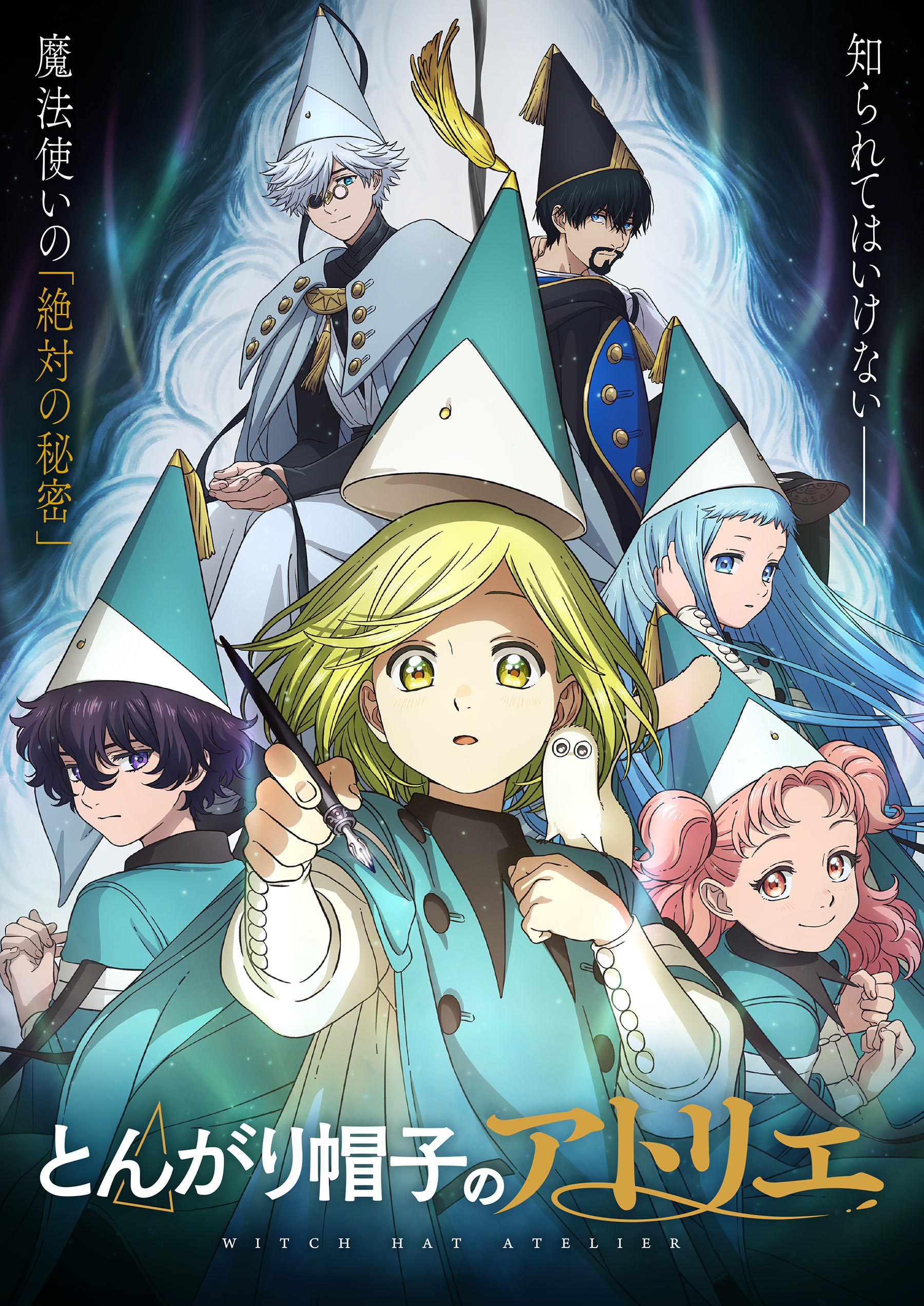
Season
Season 1
Genre
Fantasy • Adventure • Magic • Drama
Studio
BUG FILMS
Introduction to Witch Hat Atelier
Witch Hat Atelier is a fantasy anime based on the acclaimed manga by Kamome Shirahama. The story takes place in a beautiful world where magic is part of everyday life, yet ordinary people are not allowed to know how magic is actually performed.
The central character is Coco, a young girl from a small village who has always dreamed of becoming a witch. She admires magic and sees it as something beautiful and mysterious, but she does not understand the rules that surround it.
Everything changes when a young witch named Qifrey arrives at Coco’s village. Coco secretly watches him perform magic and accidentally discovers a secret that completely changes her understanding of the magical world.
The official story describes a world where only witches are supposed to cast magic and where ordinary people must not witness the moment magic is performed. Coco’s discovery becomes the beginning of her journey into that hidden world.
Official Witch Hat Atelier key visual
A World Where Magic Has a Secret
One of the most interesting ideas in Witch Hat Atelier is that magic is not simply an ability that some people are born with. The world treats magic as something that can be learned through special tools and magical symbols.
This creates an important difference between what Coco believed about witches and what she eventually learns. Magic is not just about waving a wand or possessing supernatural power. It involves knowledge, technique, symbols, rules, and responsibility.
The secrecy surrounding magic also creates a social boundary between witches and ordinary people. That boundary becomes increasingly important as Coco begins learning the truth.
Coco — A Girl Who Dreams of Magic
Coco is the emotional center of the story. Before meeting Qifrey, she lives a simple life and helps her mother in their village.
Her fascination with magic is innocent. She is attracted to the beauty and wonder of magical objects without understanding the risks involved.
Once Coco learns that magic can be created by drawing special casting seals, her entire life changes. She becomes Qifrey’s apprentice and begins studying magic alongside other young students.
Coco’s greatest strength is her curiosity. She constantly wants to understand how things work, and that curiosity pushes her forward even when the magical world becomes frightening.
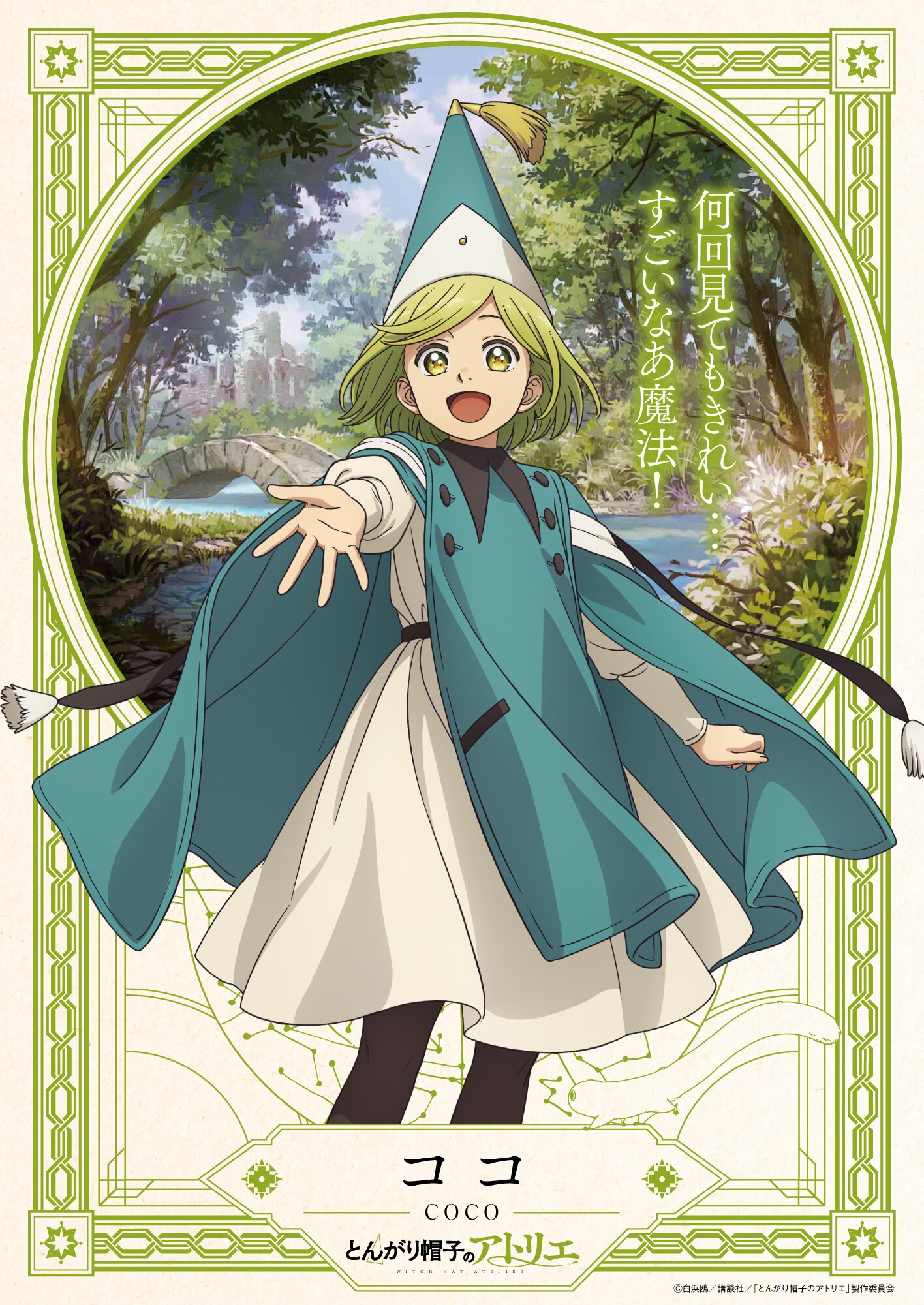
Coco — Official character visual
Qifrey — Coco’s Teacher
Qifrey is the witch who becomes Coco’s teacher. He is experienced, intelligent, and much more complicated than his friendly appearance initially suggests.
Qifrey teaches Coco the fundamentals of magic while also trying to protect her from dangers she does not yet understand.
His role is not simply that of a traditional teacher. He is also connected to the deeper mysteries surrounding forbidden magic and the strange events that eventually threaten Coco and the other students.
The relationship between Coco and Qifrey becomes one of the emotional foundations of the series.
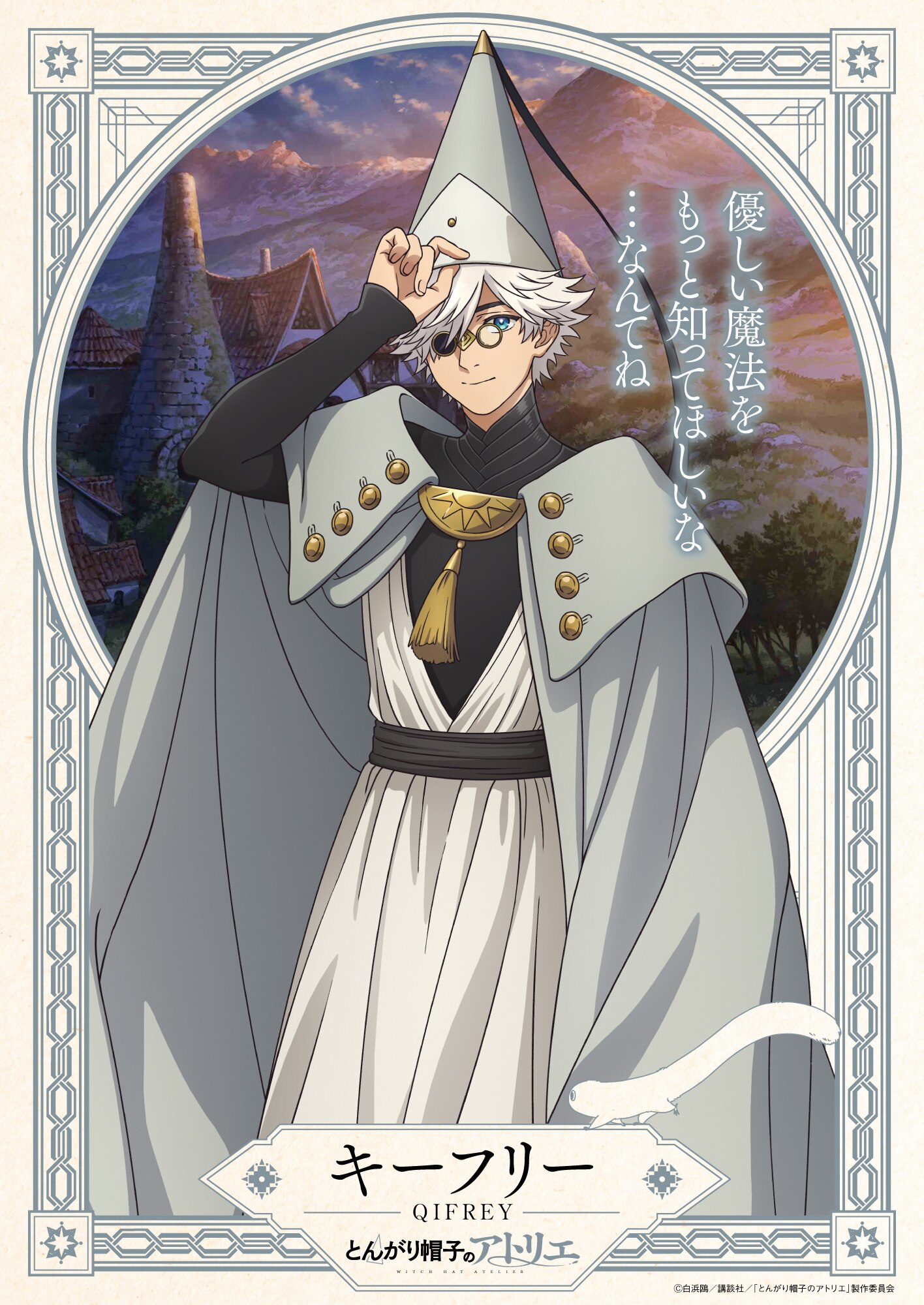
Qifrey — Official character visual
Agott — The Serious Apprentice
Agott is another apprentice studying under Qifrey. Compared with Coco, she is much more disciplined and focused on proving herself.
Agott’s relationship with Coco is complicated because their attitudes toward magic are very different.
Coco approaches magic with curiosity and wonder, while Agott is much more concerned with skill, achievement, and becoming a proper witch.
Their differences create tension, but they also make their development together more interesting.
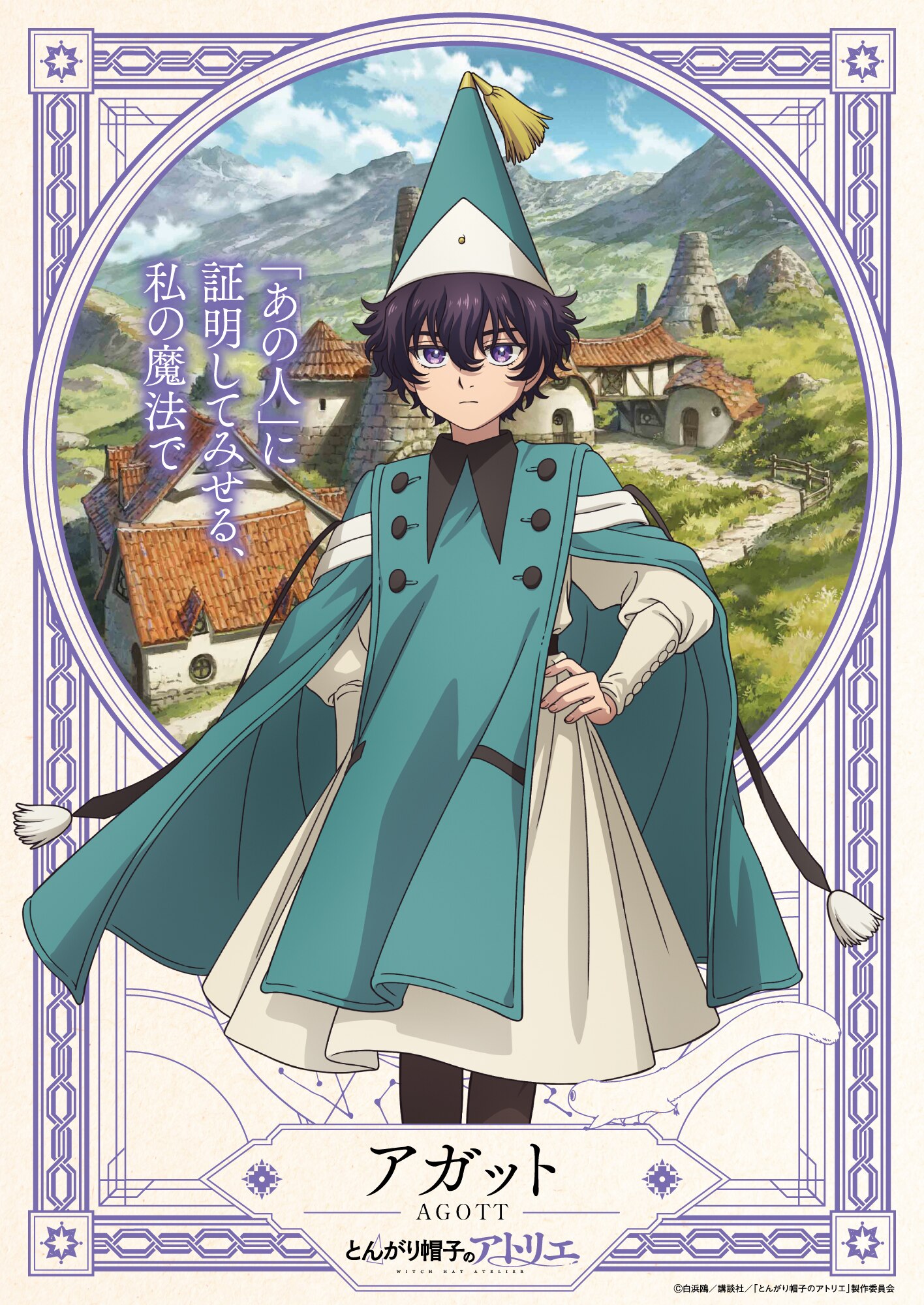
Agott — Official character visual
Tetia — The Bright Apprentice
Tetia brings a warmer and more cheerful personality to the group. Her attitude helps create a more welcoming environment for Coco.
While the world of Witch Hat Atelier can become dark and dangerous, Tetia’s personality provides moments of friendship and optimism.
Her relationship with the other apprentices demonstrates that the atelier is not only a school for magic. It is also a place where young characters learn how to trust and support each other.
Richeh — A Different Kind of Student
Richeh is another apprentice whose personality and approach to magic make her stand out.
The official story later reveals that Richeh previously ended a master-apprentice relationship before coming to Qifrey’s atelier. Her refusal to accept other people’s magic becomes an important part of her character.
Her attitude is challenged when Qifrey arranges for her to take part in another major examination.
The Atelier
The atelier itself is one of the most memorable elements of the series. It is a home, a classroom, a workshop, and a place where magical knowledge is shared.
Books, pens, magical tools, casting seals, strange creatures, and other objects fill the environment.
The detailed design of the atelier reflects one of the core strengths of Witch Hat Atelier: the world feels carefully constructed rather than being a simple background for the characters.
Magic Through Casting Seals
Witch Hat Atelier presents magic in a distinctive way. Instead of relying entirely on spoken spells, witches use casting seals drawn with special tools.
This makes magic feel closer to drawing, writing, and engineering. The shape of a seal determines how the magic behaves, meaning that understanding the system is essential.
Coco’s artistic curiosity therefore becomes an important part of her progress as an apprentice.
The official introduction explains that the world’s secret is that
anyone can potentially use magic by drawing a Casting Seal with
special tools. Coco discovers this hidden truth after secretly
watching Qifrey perform magic.
The Beauty of the Magical World
One of the defining features of Witch Hat Atelier is its visual approach to fantasy. Villages, forests, workshops, magical objects, clothing, and creatures are designed with an almost illustrated quality.
The anime adaptation works to preserve this feeling through detailed backgrounds and carefully designed environments.
Magic is not presented only as explosions or combat. It can appear as light, movement, transportation, architecture, protection, and everyday convenience.
The First Examination
Coco and the other apprentices are eventually faced with examinations that test their ability to use magic.
These tests are important because they show that learning magic is not simply about memorizing spells. Students must understand their tools, their surroundings, and the consequences of what they create.
Coco’s approach to the examinations is different from the more experienced students because she is still learning how the magical system works.
The Dada Mountains
The Dada Mountains provide the setting for one of the early major tests.
The examination places the apprentices in an unfamiliar environment where they must apply what they have learned.
The mountain setting also demonstrates how magical environments can become part of the examination itself.
Karun and New Encounters
The story eventually takes Coco and the others beyond the immediate surroundings of the atelier.
These journeys introduce new locations, characters, and challenges. The wider world makes it clear that Qifrey’s atelier is only one small part of a much larger magical society.
Tartah and Nolnoa
Tartah and Nolnoa become important characters as the story expands. Their involvement shows another side of the magical community.
The series uses these encounters to explore the practical side of magic and the different ways people interact with magical tools.
The Magic Knights and Their Suspicion
Not everyone in the magical world sees Coco and her companions as harmless students.
The Magic Knights are responsible for protecting magical society and investigating dangerous situations. Their appearance introduces a more serious atmosphere.
Their suspicion also raises an important question: what happens when the rules designed to protect magic begin to threaten the people who are trying to learn it?
Easthies and the Magic Knights
Easthies becomes one of the important figures associated with the Magic Knights.
His presence introduces a more official perspective on the magical world and its rules.
The conflict between individual witches and institutions becomes increasingly important as the story progresses.
Witch Hat Atelier — Official anime visual
The Brimmed Hats
The mysterious group known as the Brimmed Hats represents one of the darker elements of the story.
Their connection to forbidden magic and their willingness to challenge established rules make them a major threat to the magical society.
Their presence also connects Coco’s personal journey to a much larger conflict.
Forbidden Magic
Forbidden magic is one of the central mysteries of Witch Hat Atelier. The magical society has strict rules about what kinds of magic can be performed.
These restrictions are not presented as simple background information. They directly affect Coco, Qifrey, the apprentices, and the wider magical community.
As Coco learns more, the difference between legal magic and forbidden magic becomes increasingly difficult to ignore.
Qifrey’s Hidden Motivation
Qifrey is not simply teaching Coco because he happened to meet her. He has his own reasons for investigating the darker side of magic.
His personal history gradually becomes connected to the mysteries surrounding the Brimmed Hats.
This gives Qifrey’s character an additional layer and creates a contrast between his role as a caring teacher and his private investigation.
Olruggio — The Watchful Witch
Olruggio is another important adult figure within the magical world. He has a practical personality and often acts as a counterbalance to Qifrey.
His relationship with Qifrey provides some of the series’ quieter character moments while also showing that adult witches have their own disagreements and responsibilities.
The Emotional Core of Coco’s Story
Coco’s journey is fundamentally about learning. She begins with a simple dream of becoming a witch and gradually discovers that magic has rules, consequences, history, and danger.
The story does not remove her sense of wonder. Instead, it challenges her to understand the responsibility that comes with that wonder.
This gives Coco’s growth a strong emotional foundation.
Friendship Between the Apprentices
Coco, Agott, Tetia, and Richeh have very different personalities. Their differences initially create tension, but they gradually begin to understand each other.
Their friendship is important because the students are often placed in situations where cooperation becomes necessary.
Each apprentice brings a different strength to the group, creating a balance between curiosity, discipline, optimism, independence, and experience.
The Second Examination
The second major examination becomes one of the most important storylines toward the end of the season.
Agott wants to prove her ability and become a full-fledged witch as quickly as possible. Richeh is pushed into the examination despite her own resistance, while Yuiniy enters after having failed the same test twice.
The three apprentices enter the Serpent’s Back Cave, where they face another difficult magical challenge.
Richeh’s Past
Richeh’s history becomes more important during the second examination. Her refusal to accept another person’s magic reflects experiences from her previous apprenticeship.
Her character demonstrates that magical education is not always a straightforward relationship between teacher and student.
Yuiniy
Yuiniy enters the second examination with a very different emotional background.
Having already failed the examination twice, Yuiniy’s participation adds another layer to the test.
His presence gives the examination a stronger sense of pressure, because success and failure have already become personal experiences for him.
The Serpent’s Back Cave
The Serpent’s Back Cave becomes the setting for the later examination. Its dangerous environment forces the apprentices to use their magic carefully.
The cave is not simply an obstacle. It becomes a place where the students’ personalities, relationships, and magical abilities are tested simultaneously.
The Final Episode
Episode 13 is titled “Forbidden Magic.” According to the official story synopsis, Agott, Richeh, and Yuiniy become separated from Alaira following an attack by the Brimmed Hats.
The three apprentices use the magic they know and cooperate while attempting to escape their pursuers.
Outside the cave, Qifrey, Coco, and Tetia realize that something has gone wrong after receiving an SOS from Alaira. They are also attacked, and Qifrey suffers a serious injury while protecting Coco and Tetia.
The Season 1 finale is Episode 13, “Forbidden Magic.” The official story
page confirms that the episode centers on the Brimmed Hats’ attack and
the danger faced by both the apprentices inside the cave and Qifrey’s
group outside.
Animation by BUG FILMS
Witch Hat Atelier is animated by BUG FILMS. The studio is credited with animation production, while Ayumu Watanabe serves as director and Shun Shinohara as assistant director.
Hiroshi Seko handles series composition and screenplay, while Kairi Unabara is credited for character design and chief animation direction.
The production team has the difficult task of translating Kamome Shirahama’s highly detailed fantasy artwork into animation.
The Visual Identity
The anime’s visual identity is built around soft colors, detailed environments, elaborate clothing, magical symbols, and carefully constructed fantasy locations.
The official production materials emphasize the picture-book-like beauty of the world, and that approach is visible in the character designs and backgrounds.
Music by Yuka Kitamura
Music for the anime is composed by Yuka Kitamura. The soundtrack helps establish the contrast between the peaceful beauty of the magical world and the darker dangers hiding underneath it.
Quiet atmospheric passages are particularly important because Witch Hat Atelier often allows its environments and characters to breathe instead of constantly relying on large action sequences.
Opening Theme
The opening theme is “Kaze no Anthem feat. suis from Yorushika” by Eve.
The official anime site describes the opening sequence as a fantastical presentation of the magical world, featuring Coco, Qifrey, and the other members of the atelier.
Ending Theme
The ending theme is “Tada Utsukushii Noroi” by Nakamura Hak.
The official ending sequence begins with Coco walking down stairs through darkness using candlelight, creating a more mysterious and reflective mood.
The Difference Between Wonder and Danger
Witch Hat Atelier repeatedly contrasts beauty with danger.
Magic can make daily life easier and more beautiful, but the same magical knowledge can also be abused.
Coco begins the story seeing magic almost entirely as something wonderful. Her education forces her to understand that knowledge comes with responsibility.
The Importance of Rules
The magical society has strict rules because magic can affect people’s lives in ways ordinary people may not understand.
These rules create tension throughout the story. The apprentices want to learn and experiment, while experienced witches understand that some mistakes can have permanent consequences.
Coco’s Growth
Coco begins as an outsider with no formal magical education.
Over time, she learns how to draw casting seals, understand magical tools, work with other apprentices, and deal with the consequences of her choices.
Her progress is not presented as instant mastery. She makes mistakes, asks questions, struggles with difficult techniques, and learns from the people around her.
Agott’s Growth
Agott’s development is closely connected to her desire to prove herself.
Her serious attitude sometimes creates distance between her and the other apprentices, but her interactions with Coco and the group force her to reconsider how she approaches both magic and friendship.
Richeh’s Independence
Richeh’s refusal to rely on other people’s magic is one of the more unusual character traits in the atelier.
Her storyline asks questions about independence, trust, and the relationship between a student and a teacher.
Tetia’s Kindness
Tetia helps maintain the emotional balance of the group.
Her cheerful personality allows the series to maintain warmth even when the larger story becomes increasingly serious.
The Darker Side of the World
The beautiful world of Witch Hat Atelier contains a much darker side. Forbidden magic, secret organizations, dangerous creatures, and institutional rules all exist beneath the surface.
The contrast between the peaceful atelier and the dangers outside it becomes increasingly clear as Coco’s education continues.
Why the Story Feels Different
Witch Hat Atelier is not built entirely around battles. Its strongest moments often come from discovery, learning, friendship, and the exploration of its magical rules.
When action does occur, it carries more weight because the audience understands how unusual and dangerous magic can be.
This balance between quiet fantasy and darker conflict gives the series its distinctive atmosphere.
Fantasy and Coming of Age
At its heart, Witch Hat Atelier is also a coming-of-age story.
Coco enters the magical world with the excitement of someone discovering a dream. As she learns more, she begins to understand responsibility, failure, friendship, fear, and the consequences of knowledge.
Her journey is therefore about more than becoming a witch. It is about discovering what kind of person she wants to become.
The World Beyond the Atelier
The first season establishes only part of the larger magical world. The characters travel to different locations and encounter people with different relationships to magic.
This expanding world suggests that Coco’s education will eventually involve much more than the small atelier where her journey began.
Season 1 Story Structure
Season 1 consists of 13 episodes, beginning with Coco’s discovery of the secret of magic and gradually expanding into examinations, investigations, new characters, and the conflict surrounding the Brimmed Hats.
The final episodes move into the second examination and the dangerous events surrounding the Serpent’s Back Cave.
Official Cast
Rena Motomura voices Coco, while Natsuki Hanae voices Qifrey. Hibiku Yamamura plays Agott, Kurumi Haruki plays Tetia, Hika Tsukishiro plays Richeh, and Yuichi Nakamura plays Olruggio.
Additional cast members include Kotono Mitsuishi as Alaira, Hiiro Ishibashi as Euini, Mutsumi Tamura as Tartah, Yoshito Yasuhara as Nolnoa, Junichi Suwabe as Easthies, Jun Kasama as Utowin, and Hiroki Yasumoto as Galga.
Official Production Team
Original work is by Kamome Shirahama. Ayumu Watanabe directs the series, with Shun Shinohara as assistant director and Hiroshi Seko handling series composition and screenplay.
Kairi Unabara handles character design and chief animation direction. Satoshi Nakano is chief animator, Ryota Goto is art director, Naomi Nakano handles color design, and Yuka Kitamura provides the music.
Season 2
The official anime website has already released a super-teaser for the second season. This means Coco and the other characters will continue their magical journey beyond the first season.
The first season establishes the rules, characters, conflicts, and mysteries that form the foundation for the next chapter.
Final Thoughts
Witch Hat Atelier combines beautiful fantasy imagery with a carefully structured magic system and a character-driven story.
Coco’s journey from a village girl who dreams about magic to an actual apprentice witch gives the series its emotional center.
Around her, Qifrey, Agott, Tetia, Richeh, Olruggio, the Magic Knights, and the mysterious Brimmed Hats create a much larger story about knowledge, responsibility, friendship, and forbidden magic.
Season 1 ends with the danger surrounding the second examination and the Brimmed Hats becoming impossible to ignore. With the second season already teased officially, the magical world of Witch Hat Atelier is set to expand even further.
Watch Witch Hat Atelier
Witch Hat Atelier is officially streaming on Netflix, ABEMA, Crunchyroll, and other platforms depending on region.
© AnimeZones — Anime Collection